
Dynatuners | Smarter Business Solutions with Microsoft D365

Dynamics 365 F&O Solutions

Integration | Finance & Supply Chain Consulting | Copilot + AI

Harness Microsoft Dynamics 365 Finance & Operations (Finance +
Supply Chain Management) to unify your data, modernize
processes, and add AI where it truly moves the needle.
Dynatuners delivers outcomes using Microsoft-recommended
patterns and proven delivery playbooks—so you get
speed and safety from day one.

TELL US ABOUT YOUR PROJECT

Modernize an existing D365 environment, launch a new rollout, or connect D365 to the rest of your stack—we’ll shape a best-practice plan that fits your timelines, risk posture, and budget.


    Integration first.

    Designs center on Dataverse/Dual-write,
    OData + Web APIs, DMF, and Azure
    Integration Services—versioned,
    observable, and supportable.

    Update-ready by design.

    ALM aligned to One Version
    with release rings, feature
    management, and automated
    regression (RSAT + pipelines).

    01

    02

    03

    04

    Why choose
    Dynatuners for Dynamics 365 F&O?

    AI with guardrails.

    Copilot scenarios deployed where they add measurable value, with RBAC, data-minimization, and environment security baked in.

    End-to-end execution.

    From discovery and fit-gap to configuration,testing, training, go-live, and post-go-live optimization.
    SOLUTIONS WE DELIVER
    Solutions We Deliver
    01

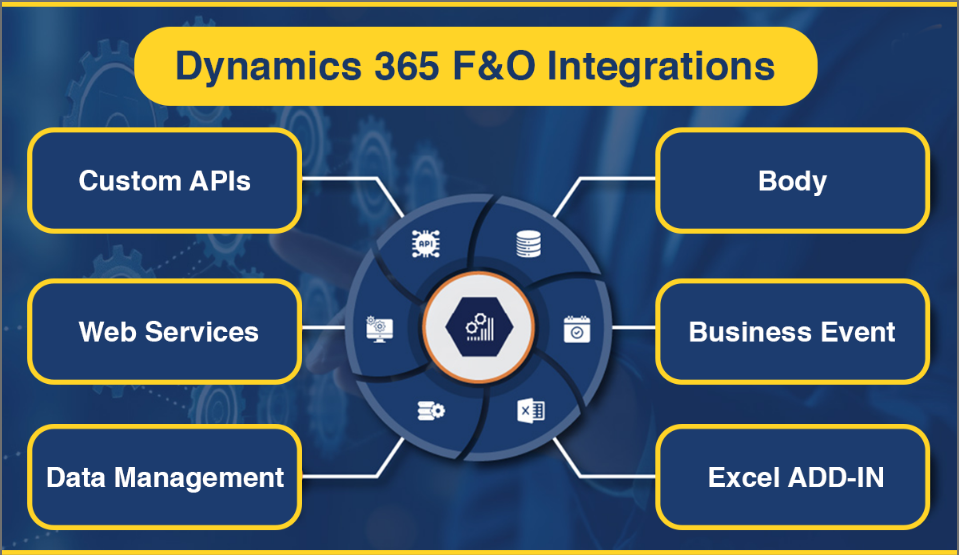
    Dynamics 365 F&O Integrations:

    Make D365 the real-time backbone of your business.
    02

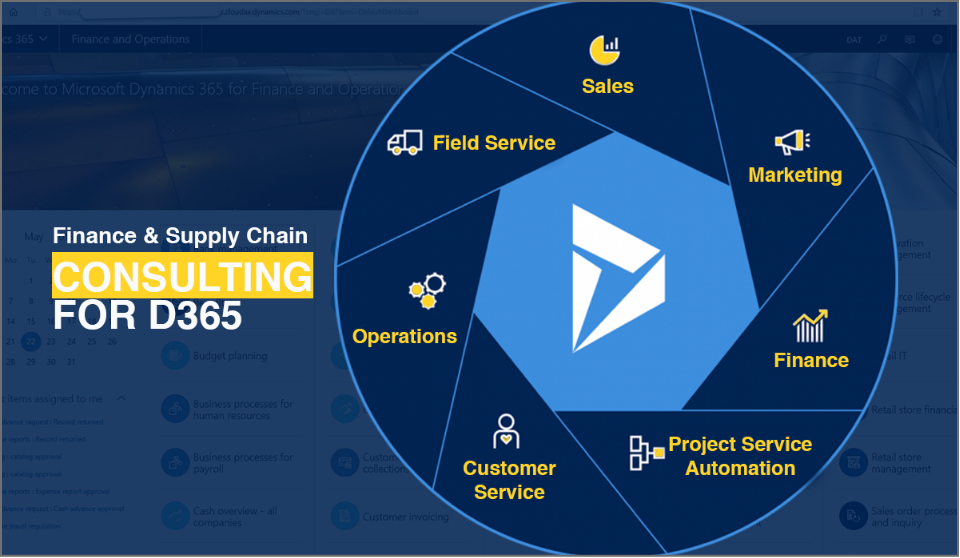
    Finance & Supply Chain Consulting for D365

    Expert configuration and process design for core ERP.
    03

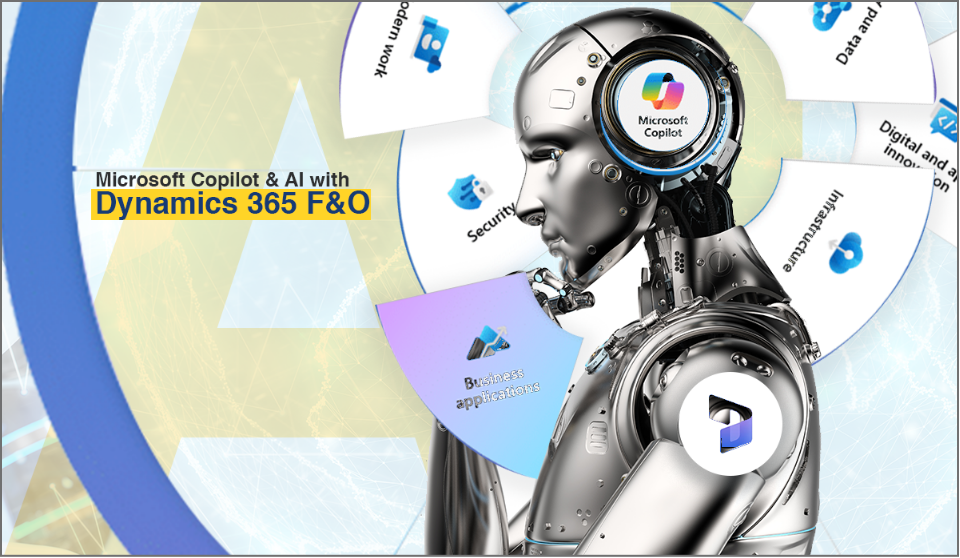
    Microsoft Copilot & AI with Dynamics 365 F&O

    Bring AI into the flow of finance and operations work.

    What we build:

    Best practices we follow:

      Common ERP System Integrations:

      Challenges WE
      solve through integration

      Data silos & fragmentation:

      unified, governed data model across apps

      Manual reconciliations & close delays:

      Copilot-assisted workflows and automated feeds

      Legacy limitations:

      phased modernization with Azure middleware

      Inventory visibility gaps:

      event-driven updates across WMS, e-commerce, 3PLs, and carriers

      Notable features & benefits

      Right-time sync:

      synchronous where users need it;
      asynchronous where volume demands it.

      Azure-native resilience:

      centralized retries, dead-lettering,
      and monitoring.

      Dataverse as the hub:

      standard schema, Power Platform
      extensibility, and CE alignment
      via Dual-write.

      Update confidence:

      release rings, feature management, and
      automated regression testing.

      Industries
      WE serve

      Manufacturing

      Distribution & 3PL

      Retail & CPG

      Healthcare & Life Sciences

      Automotive, Oil & Gas

      Professional Services

      Retail & CPG

      and more….

      FAQ

      FREQUENTLY
      ASKED QUESTIONS

      9- What artifacts will we receive from Dynatuners?

      +

      Solution blueprint, interface catalog, data contracts, test plans/RSAT suites, security/SoD matrix, cutover plan, support runbooks, and an operations dashboard spec.

      10- How do you approach data migration?

      +

      Iterative loads via DMF with reconciliation reports. We stage, validate, and sign off each domain (masters → opening balances → in-flight docs) before cutover.

      11- How do you handle performance and scale?

      +

      Design reviews include throughput targets, batch windows, and peak/load testing. We cache read-heavy calls where safe, shard workloads via queues, and monitor hot spots post-go-live.

      12- What happens after go-live?

      +

      Hypercare (stabilization, daily triage), then an AMS/continuous-improvement plan with monthly health checks, backlog grooming, and quarterly update readiness.

      13- How will Dynatuners collaborate with our security and compliance teams?

      +

      We run a security workshop early, align on encryption, secrets, network rules, and audit retention, and include security acceptance criteria in every user story.

      14- Can Dynatuners work across multiple companies, legal entities, and regions?

      +

      Yes—designs account for intercompany, multi-currency, tax/localization, and regional integrations (e.g., local e-invoicing), with governance to keep variants maintainable.

      1- How does Dynatuners de-risk integrations while moving quickly?

      We design contract-first interfaces with OpenAPI, choose the right pattern (Dual-write/OData/DMF/Azure events), and enforce idempotency, correlation IDs, and DLQs with replay. Every flow ships with runbooks, alerts, and RTO/RPO targets.

      2- When do you recommend OData vs. DMF vs. Dual-write vs. Azure Integration Services?

      +
      • OData/Web API: low-latency CRUD, smaller payloads
      • DMF: bulk and scheduled imports/exports
      • Dual-write: model-aligned, near-real-time sync with Dataverse/CE
      • Azure services: orchestration, fan-out, resiliency, partner connectivity

      3- How do you implement EDI with best practices?

      +

      We use canonical schemas, envelope/functional acknowledgments, control numbers, and re-processing queues. Business exceptions route to role-based worklists with audit trails.

      4- How does Dynatuners keep our system “One Version” update-ready?

      +

      We separate config from code, prefer extensions, maintain RSAT regression packs, and follow ringed promotion with rollback plans and pause options.

      5- What does a typical first 90 days look like?

      +

      Days 1–15: discovery, process maps, data contracts.
      Days 16–45: build/config, test data, RSAT authoring.
      Days 46–75: UAT, performance tuning, cutover rehearsal.
      Days 76–90: go-live, hypercare, metrics review, Phase 2 backlog.

      6- How do you ensure Finance and Supply Chain designs are audit-ready?

      +

      We align SoD and role design to processes, enable logging, and document evidence paths with exportable reports for auditors.

      7- How do you measure success for Copilot & AI initiatives?

      +

      Each use case has KPIs. We pilot with a control group and scale only when measurable targets are met.

      8- Will Copilot expose sensitive data?

      +

      No—access is governed by D365 roles and environment boundaries. PII is masked where feasible, actions are logged, and sensitive steps remain human-approved.

      Power Platform automation (Power Automate, Power
      Apps) and Data verse extensions.

      Analytics on Microsoft Fabric / Power BI with near-real-time
      ERP data

      Testing & quality (RSAT, pipeline-driven deployments)

      Globalization & electronic reporting

      Related services &
      solutions

      Ready to modernize your Dynamics 365 estate?

      Let’s scope your integration, optimization, or AI initiative and build a roadmap that’s fast, safe, and outcome-driven.

      Scroll to Top